

How to Spot a Crock of $%@!
You’ve seen them before – tucked in the corners of thrift stores and antique malls or even modern sets lining the walls of big box stores. The reflective grey surface with bold designs of bright cobalt blue draws collectors from around the world to find beautiful examples of Stoneware. But why? What relevance does stoneware have to our modern life? These pieces of American history leave behind a legacy, a spirit of ingenuity when faced with the age-old question – what makes the best Tupperware?
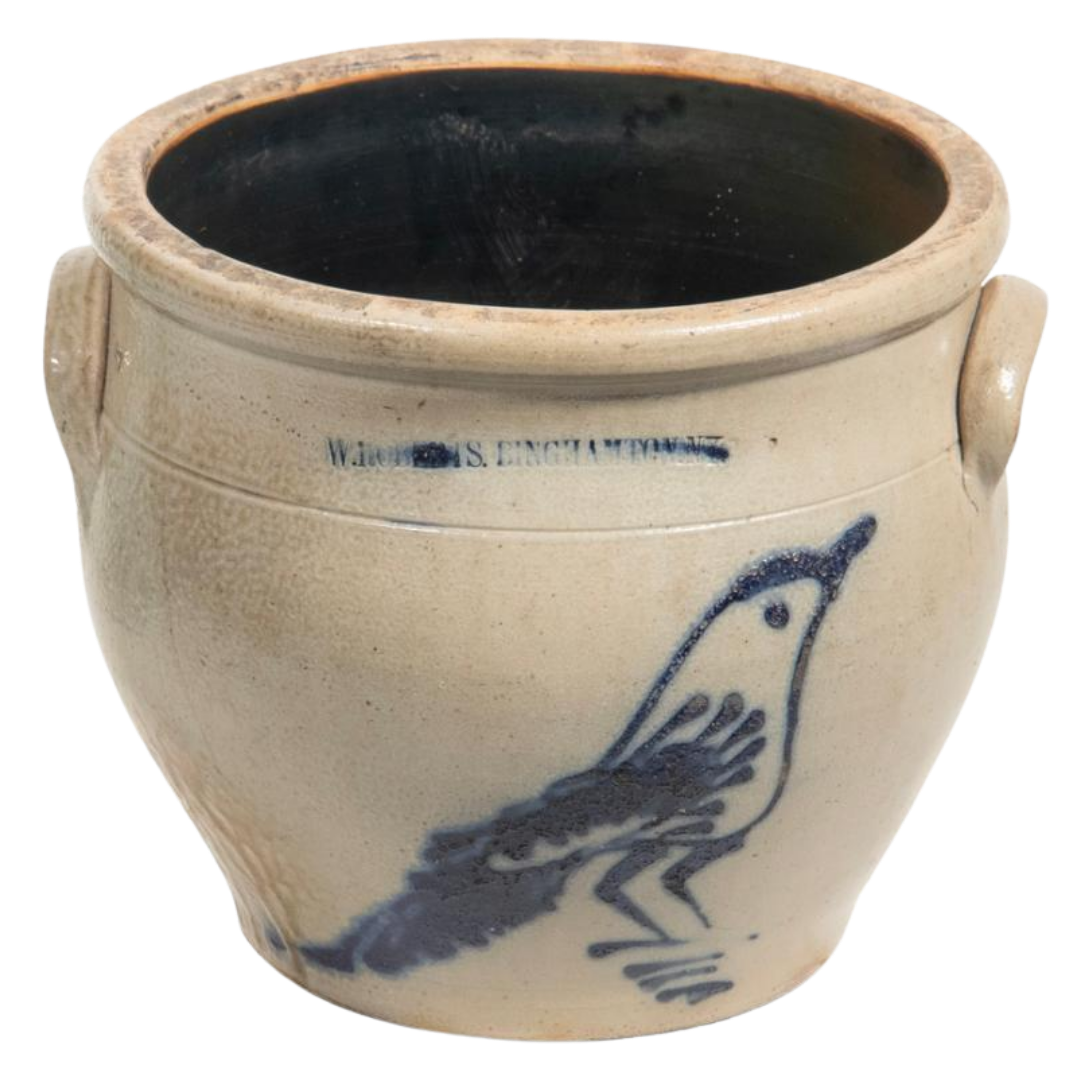
W. Roberts, Binghamton, NY Stoneware Crock with Bird
Lot 9001 | June 12th, 2026
While the New York Times may be able to point you to today’s best and brightest in food storage, Americans in the early 18th Century would tell you stoneware was unrivaled. Before, Redware was the popular form of container. Crafted from the abundant amount of natural, iron-rich clay found in North America, these pieces were first shaped by Native Americans and fired at relatively low temperatures to form unglazed vessels for utilitarian and ceremonial purposes. Redware was superseded by stoneware for two reasons: toxicity and durability.
Life in colonial America was anything but easy; incorporating lead-soaked foods into your diet doesn’t make it any easier. When unglazed, redware was not waterproof, there was no way to seal in liquids, causing the vessels to “weep” when used for food prep and storage. Through the influence of European colonists in the 17th-19th century, an ancient technique of using glaze made of lead oxide was introduced, making watertight food storage. A revolutionary design – or so one thought. When used to contain acidic food such as milk, vinegar, or cooked fruit, lead would leach into the food and cause lead poisoning among users in addition to the potters who made them.
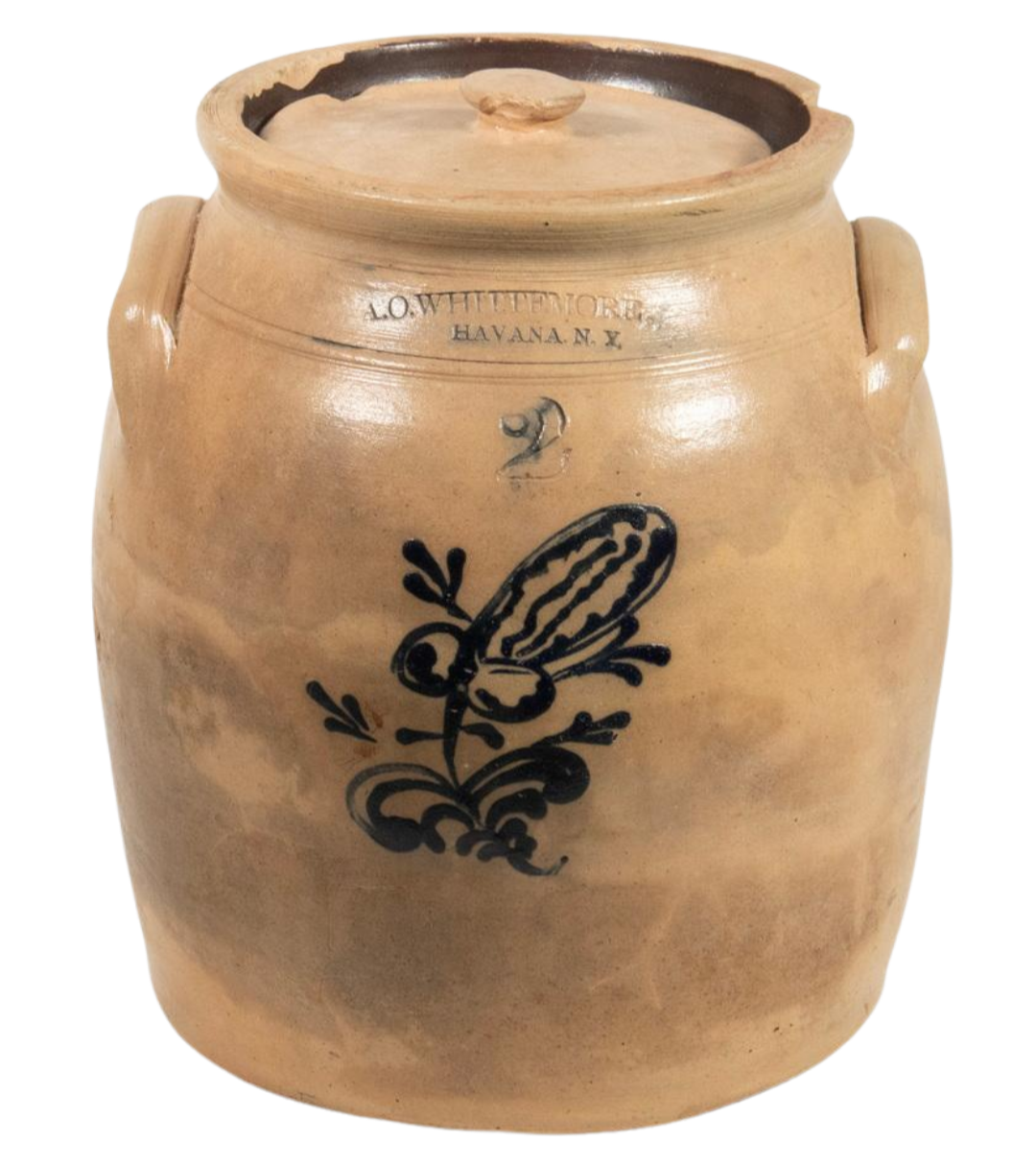
A.O. Whittemore, Havana, NY Stoneware Lidded Crock
Lot 9010 | June 12th, 2026
Then came stoneware – brought on ships from across the Atlantic, colonists quickly began to favor the heavy, durable nature with its waterproof and lead-free surface. Gray with bright cobalt blue designs, the popular alternative used a clay rich in feldspar and silica, shaped using a potter’s wheel. Deposits of such clay were found in two primary areas at the beginning of the 18th century – New Jersey and New York – and production moved to the colonies. Early makers, such as William Rogers in the early 1700s, even went so far as to operate illegal kilns, as English law favored importing the pieces from Europe. These early pieces used a salt-glaze technique developed in Germany. Table salt was thrown into a hot kiln as the pieces were curing. High temperatures are needed to fire stoneware, which in turn vaporizes the salt and reacts with the silica in the clay, resulting in a durable finish with an orange peel feel.
The earliest pieces in America were typically ovoid – a bulbous, rounded shape that tapered inwards at both the base and the neck. Looking at a piece of stoneware, it is evident how heavy the medium is. For this reason, Stoneware was sold locally until after the Civil War, when new stores and artisans began expanding across the US. Artisans altered from the curved form of ovoid and opted for more linear lines to create cylindrical walls. They could pack more, ship more, and expand their reach from the Upper East Coast. Later in the South, alkaline glazes replaced the salt-glaze as salt became sparse in the region.
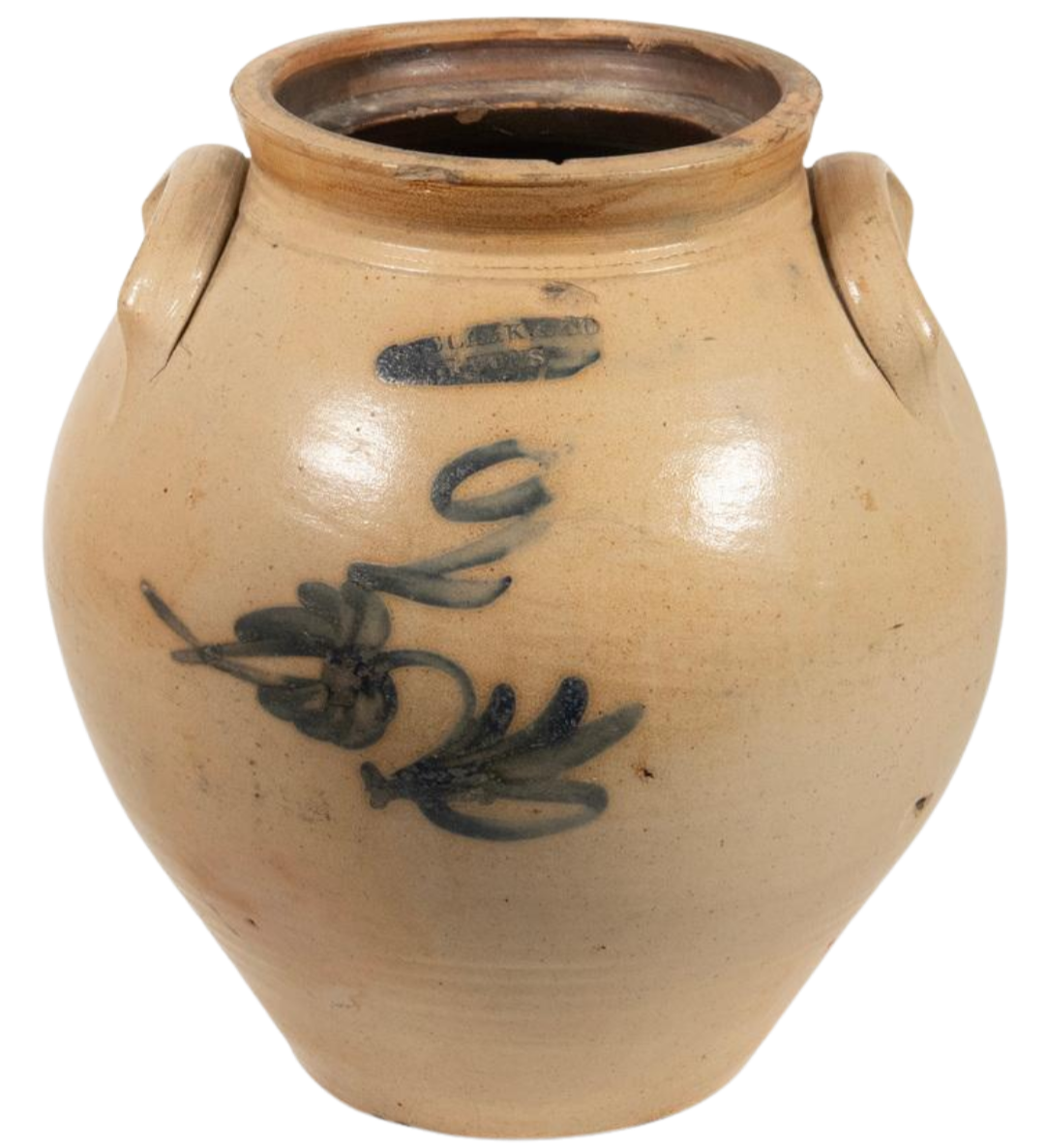
N. Clark & Co., Lyons Ovoid Stoneware Jar
Lot 9004 | June 12th, 2026
Prior to the revolutionary invention of the refrigerator, food security relied on how long food could last. The expansion of Stoneware helped provide durable, safe, waterproof containers for preserving perishables like salted meat and butter as the heavy walls helped to keep the contents at a cool temperature; for fermentation like pickles and sauerkraut without leeching lead; and for simply transporting shelf-stable liquids such as wine and whiskey!

Kaja’s Korner
How to Spot an Early Stoneware Crock
The perfect sign of an antique stoneware crock – imperfections! Today, modern replicas are typically machine-made and perfectly molded. Older, antique crocks will have organic imperfections in the glazing and construction, in addition to discoloration and chips from years of use. Look for hand-applied handles, uneven glazing, or even three “stilt” marks on the base from where the piece sat in the kiln. Modern stoneware will be sanded on the bottom for an even, flat finish.
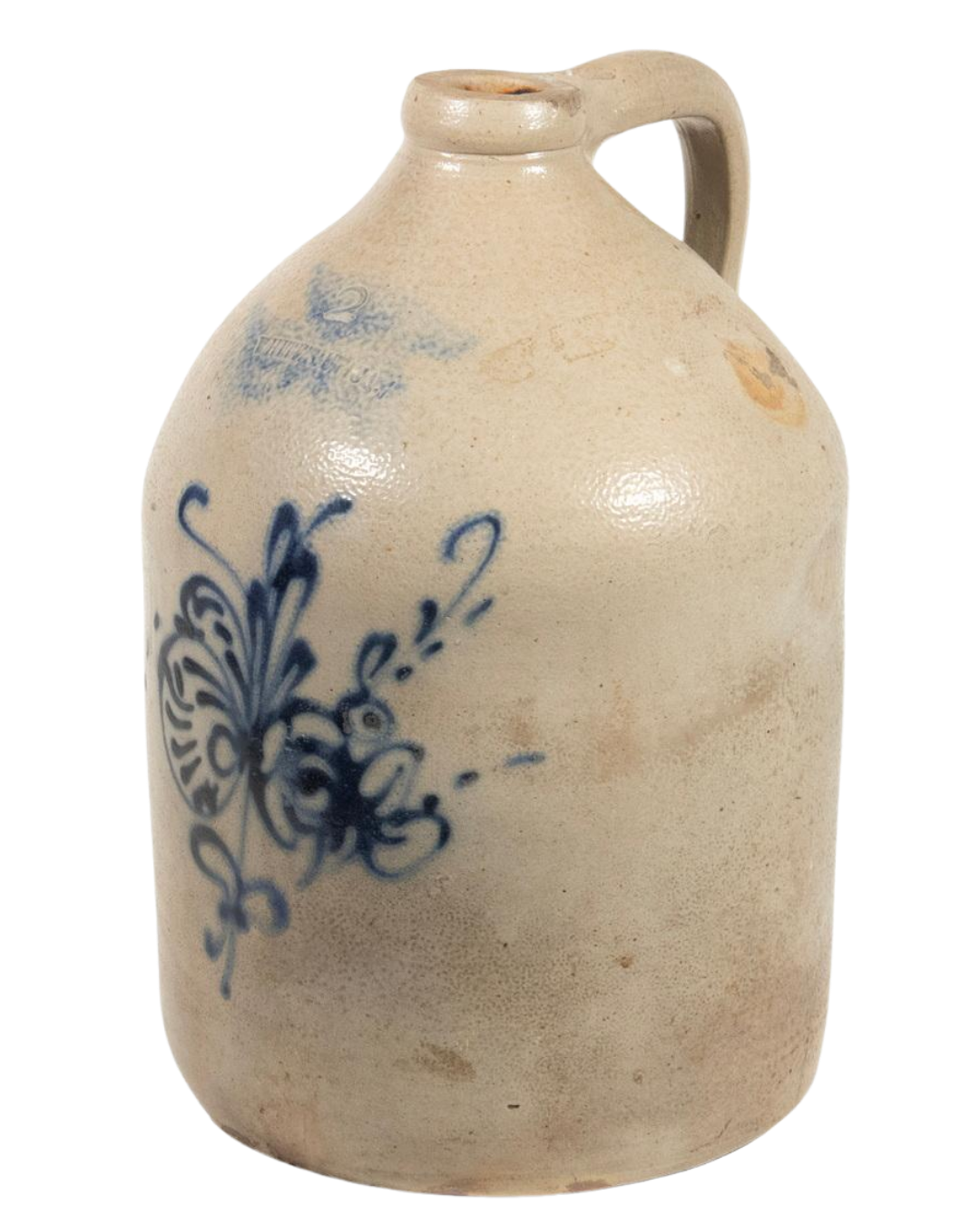
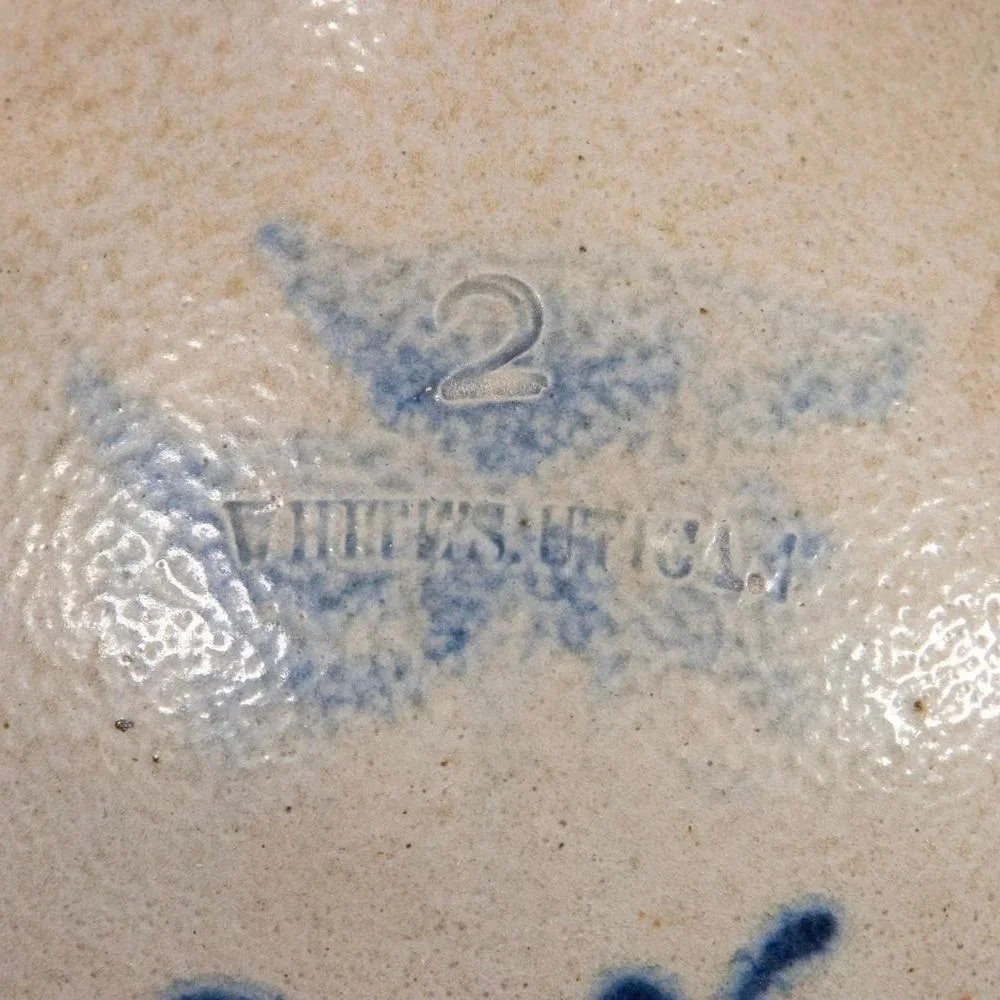
White Utica, NY Stoneware Jug
Lot 9007 | June 12th, 2026
An example of a later cylindrical jug in the 1870s. The second image provides a close-up of the “orange peel” texture resulting from the salt glaze process.
Glaze can also be a clear giveaway. Traditionally, these pieces used a salt-glaze technique that created a dimpled “orange peel” texture, which will stand out against the perfectly smooth, modern glazes we have come to know. Look closely at each design – whether a sweet bird or beautiful florals, each design should have uneven lines, brush strokes, and be baked into or lay beneath the final glaze. North American designs are much less delicate than the original Rhenish stoneware decorations from Germany. Reproductions typically have a uniform application that sits on top of the glaze layer, as well as perfectly placed maker’s marks that sit on top of the glaze or appear to be lasered in. Original maker’s marks show a slight displacement around the edges, as a stamp was pressed into wet clay.
What some may categorize as imperfections is the evidence left behind by human hands. In a world with a new Artificial Intelligence Revolution taking place, these antiques of life carry the inventiveness from those who came before.